
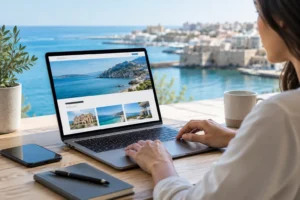
A business website in Cyprus is often judged before a prospect has read a single word. A slow property listing page, a restaurant menu that is difficult to use on a mobile phone, or a professional services site with no clear next step can send an enquiry elsewhere. Effective web design Cyprus businesses can rely on is not about adding visual effects for their own sake. It is about making it easy for the right customer to understand the offer, trust the business and take action.
For companies in Paphos and across Cyprus, the website is frequently doing several jobs at once. It may need to attract holidaymakers researching from overseas, reassure local clients, support sales teams, present complex services or manage enquiries outside normal working hours. That makes the underlying decisions about structure, speed and content every bit as important as the appearance of the homepage.
What web design Cyprus businesses need from day one
A credible website starts with a clear commercial purpose. Before colours, layouts or software are discussed, establish what the site must achieve. A yacht broker may need qualified enquiries for specific vessels. A law firm may need prospective clients to understand its areas of practice and make contact with confidence. A hotel needs availability enquiries and a convincing presentation across mobile devices, where many bookings begin.
These goals affect the site architecture. Pages should be organised around the questions a prospective customer genuinely asks, rather than around an internal company structure. A visitor should quickly see what you do, who it is for, where you operate and what to do next. If the answer takes several clicks to find, the design is working against the business.
A good brief also distinguishes between what is essential at launch and what can follow later. This is where many projects become unnecessarily expensive or delayed. A well-built website can be structured to grow, but it does not need every conceivable feature on day one. Start with the functions that support enquiries, sales, bookings or customer service, then add evidence-based improvements once the site is in use.
Mobile usability is not a smaller desktop site
For many Cyprus businesses, mobile visitors form the majority of traffic. They may be comparing restaurants while walking through town, viewing a property from abroad, or searching for a local service between appointments. Their patience is limited and their screen is small.
Mobile-first design means considering this context from the beginning. Contact details should be visible, tap targets should be comfortably sized, forms should ask only for useful information and key messages should not be buried beneath oversized imagery. Navigation needs to remain simple even where a company has a wide range of services.
There is a trade-off. A dramatic full-screen video or complex animation may look impressive on a fast office connection, but can delay the page for visitors on mobile data. The right decision depends on the audience and the purpose of the page. For most service-led businesses, fast access to clear information will outperform decorative complexity.
Speed, security and search visibility are design decisions
Website performance is often treated as a technical concern to be dealt with after the design is approved. That is a mistake. Heavy images, poorly chosen plugins, excessive scripts and page-builder clutter can turn an attractive design into a slow, frustrating website.
Speed matters commercially. Faster pages reduce the chance that visitors leave before engaging, particularly on mobile. They also provide a stronger foundation for search visibility. Search engines aim to direct users towards useful, accessible pages, and technical quality supports that aim alongside relevant content and a sensible page structure.
A lean build does not mean a plain or limited site. It means choosing each element for a reason. Images should be prepared at sensible dimensions and compressed properly. Code should be clean. Forms, sliders, pop-ups and tracking tools should be included only when they serve a measurable purpose. This approach makes a site easier to maintain as well as faster to load.
Security follows the same principle. A website should use trusted, maintained components, secure administration practices and regular updates. For WordPress sites, the quality of the setup matters more than the platform name alone. WordPress can be an excellent, practical content management system when it is configured carefully and not overloaded with unnecessary plugins.
Search visibility begins with useful pages
A business cannot expect to rank well simply because its homepage mentions a location several times. Search visibility is built through pages that answer specific user needs. A Paphos estate agency, for example, may need clear pages for buying, selling, rentals and individual property listings. A software company may need to explain its product, the problems it solves, its implementation process and the sectors it serves.
Each page needs a focused purpose, a clear heading structure and original, useful copy. Location should be included naturally where it is relevant to the service area. The strongest content does not try to impress an algorithm with repetition. It helps a real person make a decision.
Technical foundations still matter. Search engines need to access and understand the site, pages need meaningful titles and descriptions, and duplicate or thin content should be avoided. These are not glamorous tasks, but they prevent avoidable problems and give good content a fair chance to perform.
Choose technology that fits the operational need
The right platform depends on what the business needs to manage. A straightforward brochure site with news, case studies and service pages may be best served by a carefully built WordPress installation. It gives staff a practical way to update content without asking a developer to change every paragraph.
An e-commerce website has different requirements. Product variations, delivery rules, stock management, payment handling and reporting need to be considered before design begins. For some businesses, an established e-commerce platform is appropriate. Others may need a more tailored PHP/MySQL application because their workflow, pricing model or customer portal does not fit an off-the-shelf system.
Custom development should be chosen when it solves a genuine operational problem, not because bespoke code sounds more impressive. Equally, forcing a complicated process into a collection of plugins can create a fragile system that costs more to support over time. The sensible route is the one that gives the business clear control, dependable performance and room to develop without unnecessary technical debt.
Content management should not become a technical obstacle
Business owners need to update services, publish articles, change opening hours and add portfolio work without worrying that they will break the website. That requires a well-organised content management setup, not just an admin login.
Templates should be designed around the content a team actually creates. If a real-estate business regularly adds property specifications, galleries, maps and enquiry details, those fields should be structured properly. If a hospitality business updates seasonal menus and events, the process should be straightforward for a non-technical member of staff.
Training and handover matter here. A polished website that nobody feels confident using will soon become outdated. Clear guidance, sensible permissions and ongoing maintenance support protect the original investment and keep the site accurate.
Design for trust, not just attention
Visitors make quick judgements about legitimacy. Outdated design, broken links, old copyright dates, stock imagery used without care and vague claims can all undermine confidence. This is particularly relevant for businesses serving overseas customers, who may have no prior knowledge of the company beyond its website.
Trust is built through detail. Use real photography where possible, explain the process clearly, show relevant work or client feedback, and make contact information easy to verify. Professional credentials, team experience and service areas should be presented plainly rather than hidden in dense copy.
The strongest calls to action are equally direct. A visitor looking for a quote should not have to decode a clever phrase or complete a long questionnaire. Ask for the next reasonable step: request a consultation, check availability, discuss a project or call the office. Different pages may require different actions, and that is perfectly acceptable.
A website is a working business asset
Launching a site is not the end of the work. It is the point at which real visitor behaviour begins to reveal what needs improving. Enquiry patterns may show that a service needs clearer explanation. Analytics may reveal a mobile page with a high exit rate. A new product line, regulation or seasonal offer may require fresh content.
Ongoing maintenance is therefore more than applying updates. It is a practical process of keeping the site secure, accurate and useful. Small improvements made consistently are usually more valuable than leaving a site untouched for three years and then attempting a complete rebuild.
For businesses looking for web design in Cyprus, the most useful question is not which trend will make a site look newest. Ask whether the website will still be fast, manageable and commercially effective when the initial launch excitement has passed. Build around the needs of customers and staff, keep the technology proportionate, and give the site a clear job to do. That is how a website becomes an asset the business can depend on.